
Partner Program
Your expertise is not obsolete.
It needs a company around it.
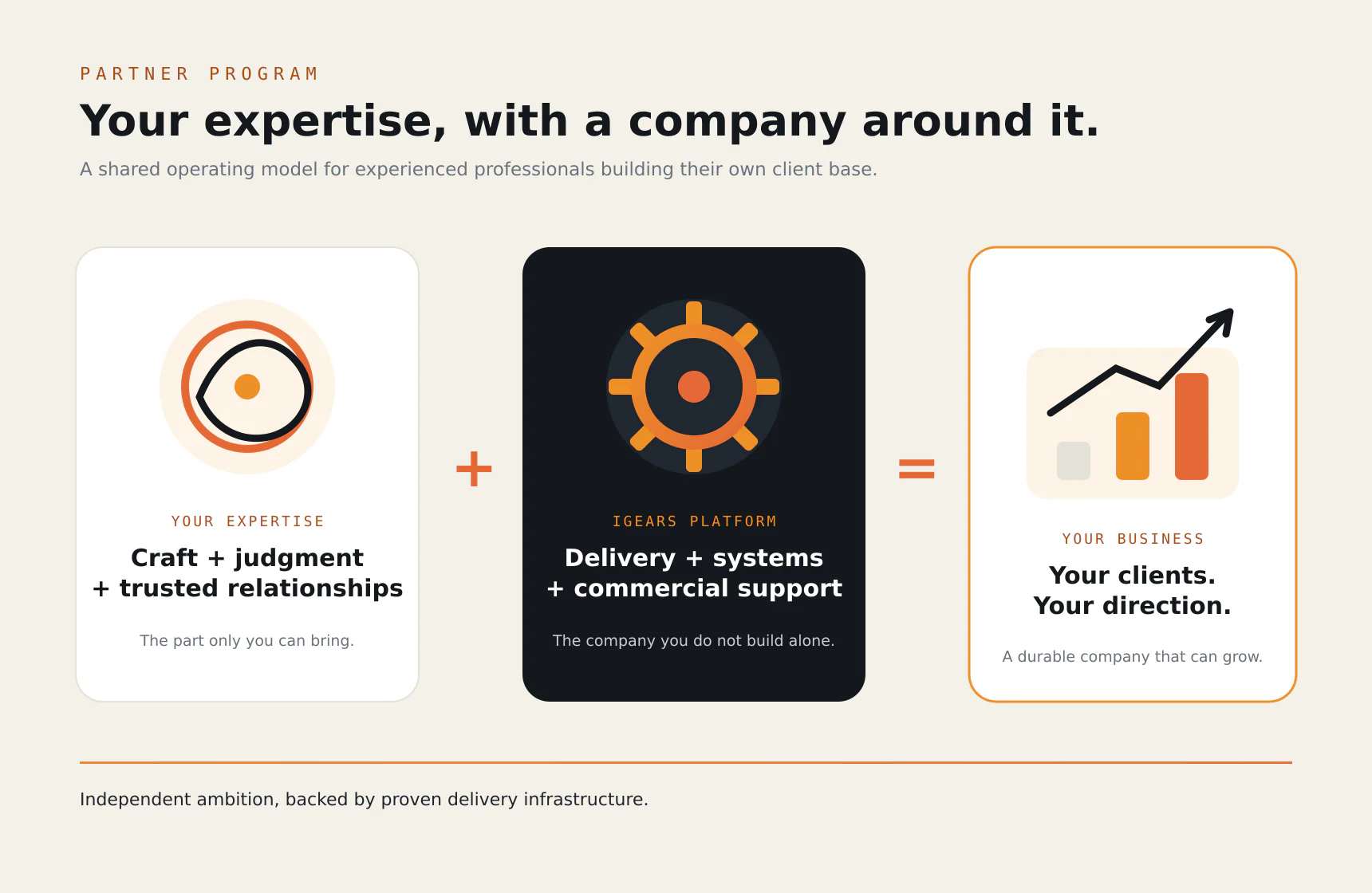
iGears is looking for experienced technology professionals who want to build their own business rather than compete with automation for a salary. You bring the craft and the client relationships. Our Hong Kong parent company provides infrastructure, platforms and a delivery bench built since 2004 — so you start with an established company behind you instead of from zero.
Why we are doing this
AI is changing who gets paid for what — faster than careers can adapt
Across our industry, capable people are finding that the work they built a career on is being absorbed, reorganised or automated. A senior Android developer with fifteen years of shipped apps is not less skilled than they were three years ago. What changed is the shape of the job market around them.
We think the answer for a lot of these people is not another job application. It is to own the client relationship instead of renting out their hours — because the part AI cannot replace is judgement, accountability and the trust of somebody who has delivered before.
What stops most experienced practitioners from going independent is never the technical work. It is everything around it: the company, the contracts, the insurance, the infrastructure, the invoicing, the credibility to be trusted with a six-figure project, and somebody to call at 2am when production is down.
Our Hong Kong parent company already has that infrastructure. It has been built since 2004 and is sitting here, largely underused, in a business that would rather share it than watch good people leave the industry.
What you get
The company you would otherwise spend two years building
Everything below already exists and already works. You are not waiting for us to build it, and you are not paying to develop it.
An established business
A Hong Kong parent company established in 2004: contracts, invoicing, banking, insurance, and a track record that lets a school board or listed company sign with you without a procurement argument.
Twenty parent-company platforms
SaaS products operated by our Hong Kong parent company — email and SMS marketing, document workflow and e-signature, HR, school and church management, booking systems, AI content tools — to white-label, resell or build on instead of starting from an empty repository.
An engineering bench
A Hong Kong development team backed by the parent company's 200+ shipped-app record, available when a project is bigger than one person, or needs a skill you do not have. You stay the client's point of contact.
Infrastructure & operations
Hosting, cloud, CI/CD, monitoring, backup, security and support rotation — the unglamorous layer that quietly sinks most one-person consultancies in year two.
Commercial support
Quotation and proposal templates that have won real work, pricing guidance, contract review, and help on client calls until you would rather take them alone.
AI adoption, done with you
The transition you are being asked to make anyway — modern tooling, AI-assisted delivery, and how to sell AI work honestly — learned alongside a team already doing it commercially.
Who this is for
Four people we would like to hear from
These are illustrations of fit, not a closed list. If you recognize the shape of your situation in any of them, the conversation is worth having.
The senior mobile or game developer
Fifteen years of shipped apps, recently laid off or watching the team shrink. Wants to start a studio but has no company, no infrastructure and no first client.
What changes: our app and game infrastructure, store accounts and publishing experience — plus our own seven-title pipeline as a working example of the path.
The web developer or designer going independent
Capable of the work, uncomfortable with quoting, contracts and chasing invoices. Undercharging because there is no benchmark to price against.
What changes: proposal templates, pricing guidance, hosting and care-plan products to sell as recurring revenue instead of one-off projects.
The IT manager whose department was restructured
Twenty years of knowing how organizations actually run their systems — the most valuable and least marketable asset in the room.
What changes: that knowledge becomes an IT services and AI transformation practice, on our platforms, with our support desk behind it.
The domain expert outside technology
Deep in education, healthcare administration, non-profit operations or church ministry — and can see exactly which processes should be automated.
What changes: you bring the domain and the relationships; we build and run the software. This is how our best vertical products started.
How it works
From first conversation to first client
- TalkAn honest hour: what you can do, what you want to build, and whether we can actually help. We will say no if we cannot.Week 1
- Shape itWhich market, which of our platforms, what you own, how revenue is split. Written down before anyone commits.Weeks 2–4
- Set upInfrastructure, tooling, templates and introductions. Your first proposals go out with the Hong Kong parent-company delivery record clearly identified.Months 2–3
- GrowYou run your business. We stay available for delivery capacity, technical escalation and the commercial questions.Ongoing
What we ask in return: that you are genuinely experienced, genuinely willing to own client relationships, and honest about what you can and cannot deliver. We are not recruiting resellers or looking for people to resell a course to. There is no joining fee, no training package to buy, and nothing to pay before you earn.
Straight answers
Partner Program FAQ
Do I need to invest money to become a partner?
No capital investment is required to start. The partner model is revenue-share: you bring the client work and the craft, we provide the infrastructure, delivery capacity and business backing. We agree the split in writing before anything begins. If you later want to invest in your own team or product, we will help you structure that — but it is never the entry price.
What exactly does iGears provide?
Infrastructure from our Hong Kong parent company, established in 2004: operating systems for contracts, invoicing and insurance; twenty parent-company SaaS platforms that may be available to white-label or resell by agreement; a Hong Kong engineering bench backed by a 200+ app track record; hosting, cloud and DevOps; proposal tools; and practical mentoring.
I am a developer, not a salesperson. Is that a problem?
That is the most common profile we work with, and it is precisely the gap we fill. Deep technical skill with no sales function is a situation we know from the inside, which is why we understand it. We can support lead generation, quotation and client-facing work while you do what you are good at, and coach you into the commercial side at whatever pace suits you.
What kinds of partners are you looking for?
Experienced practitioners with a real craft: mobile and game developers, web developers, systems and integration engineers, designers, IT infrastructure specialists, and consultants in verticals we serve — education, NGOs, healthcare, churches. We also welcome people whose role is being reshaped by AI and who want to turn that expertise into a business rather than compete with automation on the same ground.
Am I too old, or too specialized in an older technology?
Twenty years of judgement about what breaks in production is not obsolete — it is the scarcest thing in this industry right now. AI can generate code; it cannot tell a client which of three architectures will still be maintainable in five years. We will help you move your specialism onto current tooling, and your experience is the part we cannot manufacture.
Where do you accept partners from?
Canada and Hong Kong first, because those are the offices that support you. We will talk to strong candidates elsewhere. The 170-country delivery figure shown elsewhere on this site belongs to the Hong Kong parent-company record.
How long before I earn anything?
There is no guaranteed timeline or income. It depends on your existing relationships, market, offer and time commitment. We discuss a realistic first-stage plan before either side commits, and the written agreement defines responsibilities and revenue sharing.
What happens if it does not work out?
The written agreement defines client ownership, work product, confidentiality and exit responsibilities before the partnership starts. Review those terms independently and ask us about any provision that is unclear.
Start the conversation
Tell us what you can do.
No CV required and no pitch expected. Describe what you have built, what you would like to build, and where you are stuck — we will tell you honestly whether we can help, and what we think the first six months would realistically look like.
Prefer email? partners@igears.ca · Do not send client-confidential material in the first message; we can discuss an NDA before details are shared.